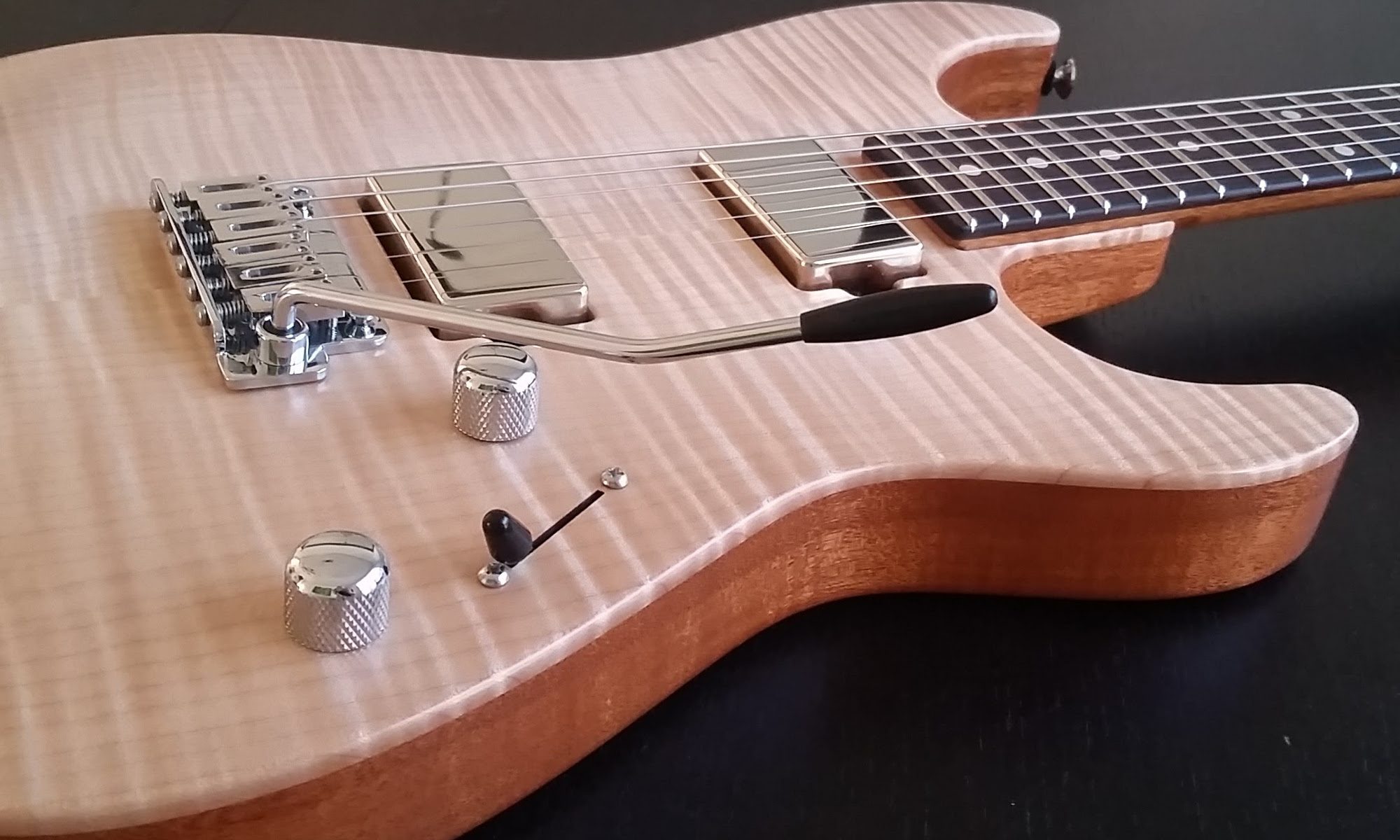
The Telecaster design dates back to 1950. While there’s been a lot of innovation in guitars over the past 76 years (as I write this), it’s fascinating to me how the bulk of the Tele has remained unchanged. There’s a cliche in the guitar space that says, “Leo got it right the first time!” There’s a lot of truth to that.
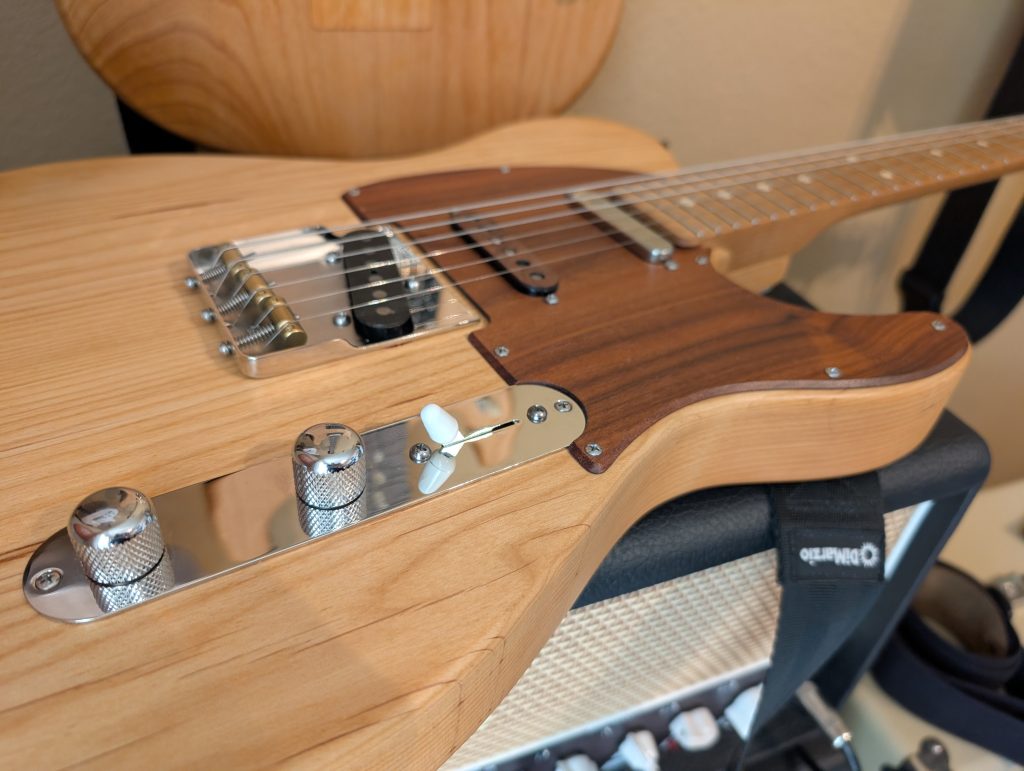
My tele journey began in the early 2000s when I started playing country music gigs. I purchased an inexpensive Mexican Tele at Guitar Center; I want to say it was $400 back then. I immediately started making changes, and thus began my “Tele of Theseus” journey. 4 necks, 3 bodies, 5 pickguards, 3 switches, 5 pickups, 5 sets of knobs, 2 tuner sets later nothing remains from the original guitar. The neck pickup (Dimarzio Twang King) is the oldest part. Several of these changes have been written about on this blog in previous posts. It’s now an inexpensive Warmoth body & neck w/ a tung oil finish sporting Dimarzio twang kings and an Vanzandt Blues in the middle position. I really love the look of the Walnut pickguard that a stumbled across on Etsy of all places. It’s a great guitar.
I’m an optimizer and always looking to make improvements. I’m going to document several of the recent changes I made this year with product links. None of this is a paid endorsement, and I have no affiliations with these company and there is no compensation. I am strictly documenting for the potential benefit of others. Let’s go!
New Changes
I started with a modern 6-block saddle bridge. While these are great, they’re not very “tele” in the traditional since. I went with a Gotoh ashtray bridge w/ compensated barrel saddles in 2015 and it’s been great. The thing is with an ashtray bridge is my fingers catch on the lower ridge sometimes, and while I’m decent enough at working around it, I no longer want to deal with that. Philadelphia Luthier sells a bridge with “stagged sides” which solves this problem. It was really simple to move my Gotoh compensated saddles over to the new bridge.
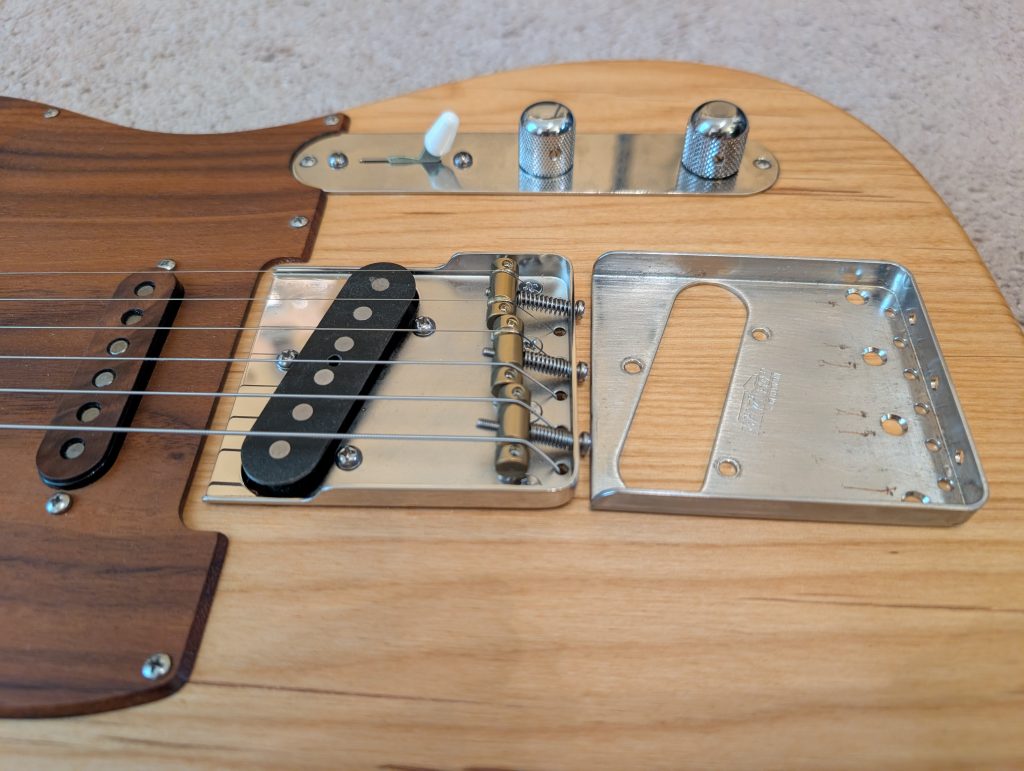
I had done some accelerated aging to the last bridge and control plate and at this point in my life I’m kinda done with relic’ed guitars. The new bridge didn’t match my current control plate. This was a rabbit hole of options that I don’t remember existing 10-15 years ago. There are almost too many options for control plates, but I settled on an amazing mod that I’ve been really happy with. This control plate, also from Philadelphia Luthier, slightly moves the volume pot so there’s a little more room to get your pinky on the switch. It’s simply brilliant. I believe I heard Callaham sells a similar plate, but they either weren’t in stock or I couldn’t get the finish I wanted. Either way I’m really happy with the one I got.
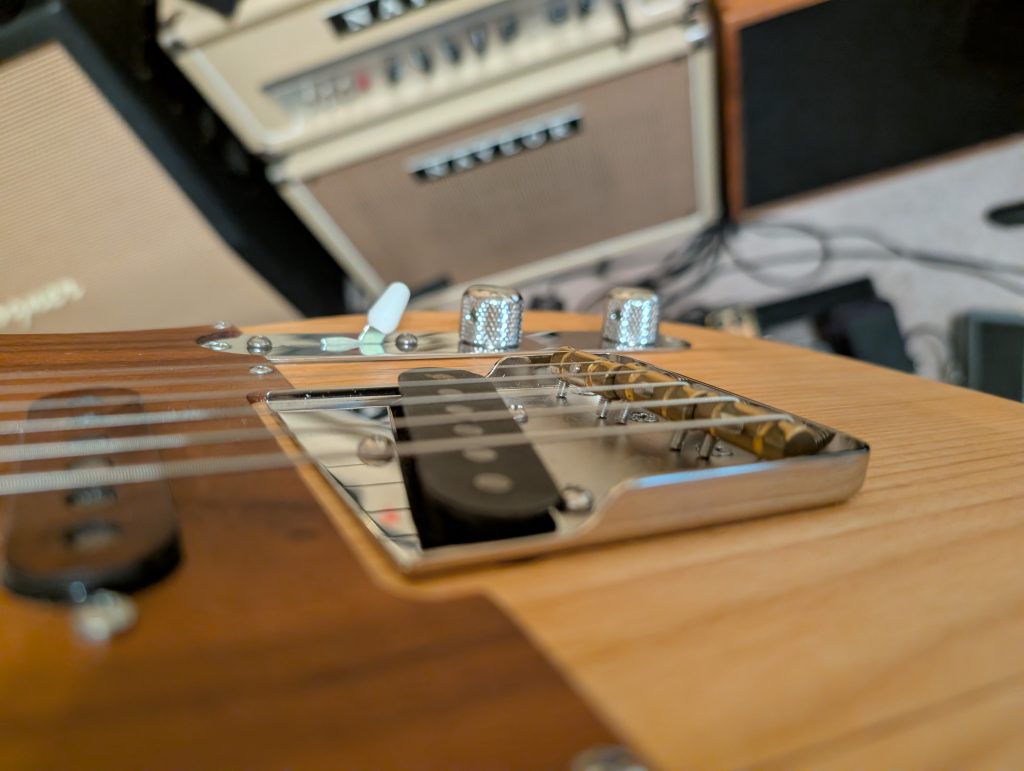
My beloved 2-pole switch, which preserves the traditional B+N configuration in the middle position, was easy to move over. This was not the case for the knobs as the old ones had fused in place and I was unable to remove them. Speaking of knobs, this ended up being a hole other rabbit hole. My favorite knob is the short Gotoh VK3. It’s what Tom Anderson uses, and it’s perfect. The problem is it’s a 6mm hole, and these pots have 6.35mm (.25″) shafts. I didn’t want to go split shaft, and the smaller ones won’t fit the control plate. Fortunately, Philadelphia Luthier once again, has a fix! They sell a very similar knob that is made for teles. I thought they were perfect at first, but then I started noticing the gnarl is too smooth for my fingers to grip. My pinky was sliding along the knob and not turning it. After about the fourth time, I realized these aren’t going to work for me. The only other option I could find is a Fender Pure Vintage 52′ knob. These look great and are slightly larger diameter than the other ones, but they have the opposite problem the gnarl is too sharp and is painful to me. I don’t like hardware that hurts me! At this point, my OCD led to to just drilling out the Gotoh knob and now it’s perfect and I get everything I want. I put together the most niche youtube video on this in case others want to do this.
Closing thoughts
It’s amazing to me how both the strat & tele are “platforms” (spoken like a nerd that works for a software company!) that serve a large aftermarket industry of hardware and accessories. All of these solve problems/annoyances or maybe promise better tone and connection with peoples’ heroes. In my case, these small tweaks preserve what’s amazing about these designs and the subtle improvements remove the friction from making music. I want my guitars to facilitate my ideas and tweaks like these help the instrument get out of the way and work better for me. Worth every penny!